


What's compound interest?
Compound interest may seem complicated, but it’s not. When you save money for retirement, the interest that you may earn over time gets added to your initial contribution. Consider these steps to help maximize the benefits of compounding as you save.

How does compound interest work?
It’s simple—the interest you earn on your savings is reinvested, so you get additional money added to your account. Saving even a small amount can grow significantly over time.
What's the difference between compound interest and simple interest?
Simple interest is calculated only on the principal, which is the original amount you invested. The interest amount stays the same each time it's paid. Bonds and certificates of deposit (CDs) are examples of investment options that pay simple interest.
Compound interest is calculated on the principal plus any interest that has already been added. You earn interest on both the original amount (principal) and any interest that was added to your savings. This can help your savings grow faster over time.
Can you earn compound interest on a retirement account?
When you save in an employer-sponsored retirement plan, such as a 401(k), 403(b), or an individual retirement account (IRA), your contributions and investments have the opportunity to grow tax deferred and benefit from compounding. Contributing to your retirement plan regularly is one of the best ways to take advantage of compound interest. As your savings grow, the compound interest also grows. The earlier you start, the more time you have to build your savings to help you reach your retirement goals. One-time contributions can also help boost the power of compounding.
Also, if you withdraw your money early from your plan—it can hurt the effect of compound interest, and potential higher fees and early withdrawal penalties can reduce your overall returns.1 Consider combining your retirement accounts to potentially benefit from the lower fees that may be available in your retirement plan.2
How can you benefit from compound interest?
Let’s look at a couple of examples to help you understand the compound interest effect.
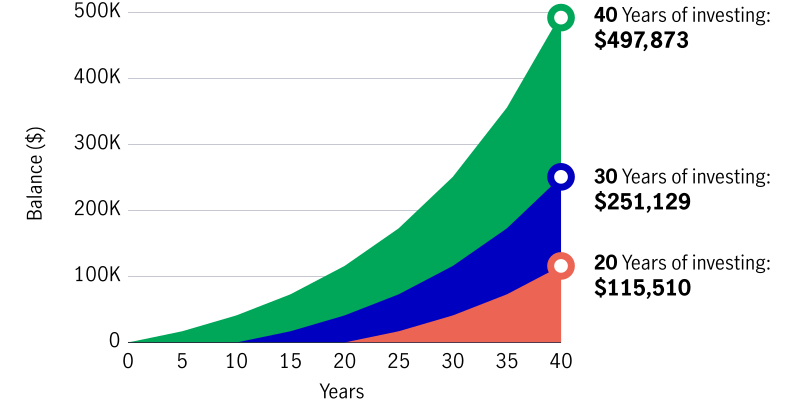
Example 1: Compound interest plus regular contributions3
You contribute $250 each month (or $3,000 annually) to a retirement account with a 6% interest rate compounded yearly. Now, at age 65:
- Starting at age 25, you could have $497,873 in savings, with $377,873 from compound interest.
- Starting at age 35, you might have $251,129 in savings, with $161,129 from compound interest.
- Starting at age 45, your total could be $115,510 in savings, with $55,510 from compound interest.
Example 2: Compound interest with no additional contribution3
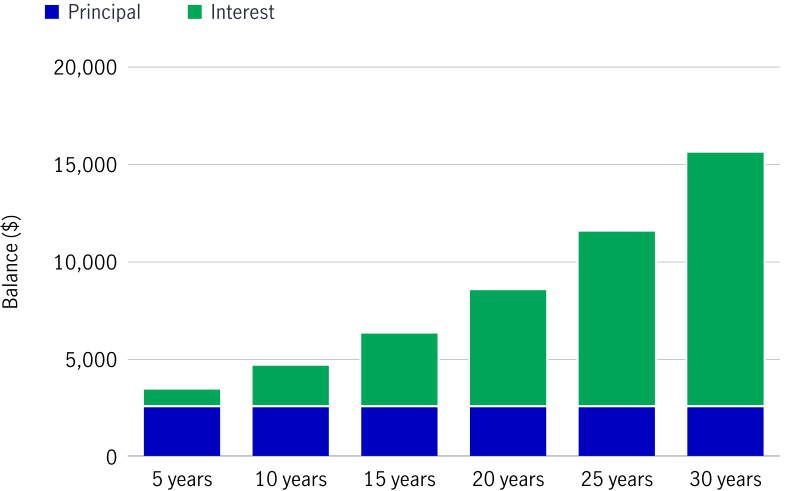
You decide to roll over $2,600 from an existing IRA into your retirement account. The annual interest rate was 6%, compounded yearly, and you didn't make any additional contributions.
Let’s see how your savings grow over time.
- After 20 years, you could have $8,607, with $6,007 coming from compound interest.
- After 30 years, you could have $15,659, with $13,059 coming from compound interest
5 tips to help maximize the effect of compound interest
Here’s how you can maximize the benefits of compound interest while saving for retirement:
- Start early if you can—but it’s never too late
- Contribute to your plan regularly
- Increase your contributions each year
- Add extra money, such as a tax refund or bonus, to your account
- Keep your money in your plan
You can reach out to your financial professional for help and more information on long-term investment strategies to help you achieve your financial goals faster.
1 Ordinary income taxes are due on withdrawal. Withdrawals before the age of 59½ may be subject to an early distribution penalty of 10%. 2 As other options are available, you are encouraged to review whether consolidating accounts, staying in a retirement plan, rolling over into an IRA, or another option is best, as there are advantages and disadvantages to each. 3 Manulife John Hancock Retirement compound interest calculator.
Important disclosures
Important disclosures
This content is for general information only and is believed to be accurate and reliable as of the posting date, but may be subject to change. It is not intended to provide investment, tax, plan design, or legal advice (unless otherwise indicated). Please consult your own independent advisor as to any investment, tax, or legal statements made.
MGTS-P 329750-GE 4/26 329750 MGR0407265351510